
Sunken or cracked sidewalks are a common headache in Austin. Expect basic leveling or patching to run about $4-$7 per sq ft, polyurethane foam lifting $6-$16 per sq ft, and partial or full repour $7-$22 per sq ft; these bands help decide whether to lift, patch, or replace and set realistic bid expectations.
Quick Local Cost Ranges
The most common homeowner-level bands in Austin are $4-$7 per sq ft for basic repairs and leveling, $6-$16 per sq ft for polyurethane foam lifts on small or specialized sections, and $7-$22 per sq ft when partial removal and repour are required. Typical flat quotes for a single panel lift or mudjacking show as $400-$1,200 depending on access and size. These ranges align with regional cost coverage on Architecture Adrenaline and local contractor examples; see the site’s focused cost guide for side-by-side benchmark figures. Austin sidewalk slab cost guide
Five Factors That Drive Final Price
Compare estimates using five practical determinants.
- Extent of Damage: One broken panel with a single trip edge requires a different scope than a continuous run of settled slabs. Use the straightedge test for vertical displacement to decide whether a panel should be replaced or can be lifted.
- Method Required: Foam injection, slurry mudjacking, and partial/full replacement have distinct labor, equipment, and long-term performance tradeoffs.
- Access and Disposal: Jobs that need lane closures, traffic control, or expensive debris hauling add discrete line items to a quote.
- Underlying Soils and Roots: Austin’s clay-over-limestone profile and nearby tree roots shorten some repairs’ lifespan; consider root mitigation or root barriers when roots are present. For technical approaches to root-related lifting and long-term fixes, consult the site’s write-up on tree-root sidewalk lifts. Tree-root sidewalk lifts
- Permits and Right-of-Way: Work in the public right-of-way commonly requires an Austin Development Services or Transportation and Public Works permit and inspection. Many contractors include permit coordination in their bids, but confirm permit fees and inspection windows are listed separately.
How Repair Methods Compare
Select a method by matching the failure mode to what each technique actually fixes.
- Polyurethane Foam Injection: Injected through small ports, fast-cure foams fill voids under slabs, raise sections, and allow near-immediate foot traffic. Foam works well where voids and shallow settlement are the cause and where adding minimal weight matters for brittle edges.
- Mudjacking (Slurry): Slurry fills and lifts panels at lower material cost but increases the load beneath the slab and can re-settle if the injected material migrates. Good for broad, accessible panels without severe edge breakage or aggressive root intrusion.
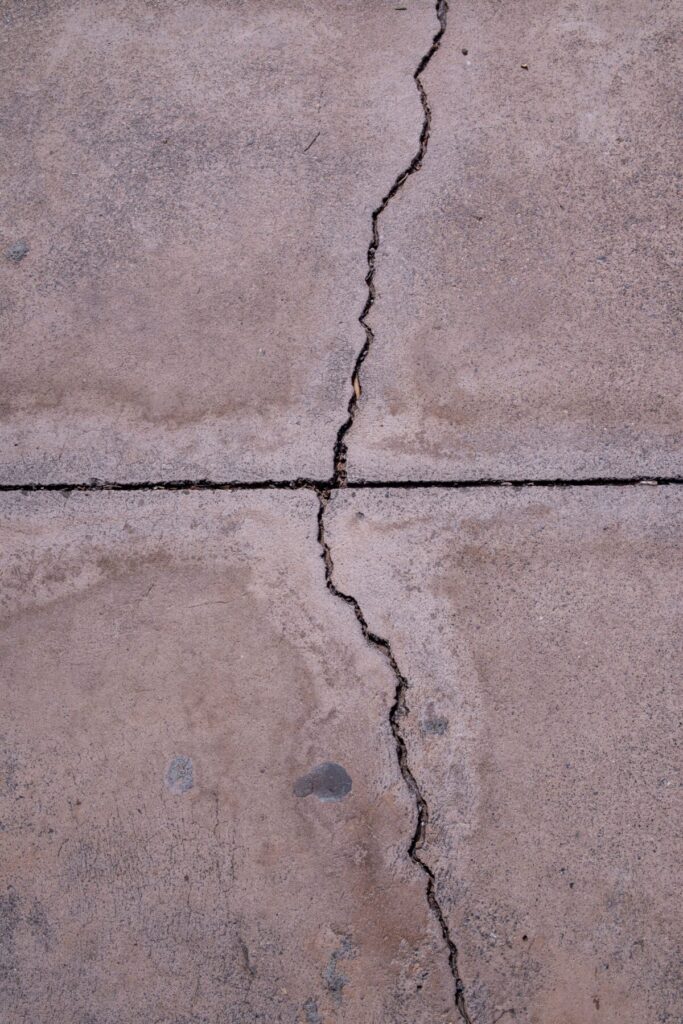
- Partial or Full Replacement: Use when slabs are shattered, heavily spalled, or exceed the city’s trip-hazard thresholds. Replacement restores slab thickness, drainage slope, and joint layout but requires curing time and controlled finishing to avoid rapid-dry cracking.
For step-by-step diagnostic procedures and repair selection criteria that contractors and engineers use, the Repair of Concrete course explains how professionals evaluate deterioration, choose compatible repair materials, and sequence work on sidewalk slabs. Repair of Concrete course (InterPro/Wisconsin)
Typical Process and Timelines
Contractors usually inspect and measure panels, mark work, drill lifting or injection ports, lift or remove slabs, correct base material, then seal or repour and perform final inspection. Foam lifts frequently take under an hour per panel with immediate use; mudjacking often completes the same day; partial replacements normally span 1-2 days including demolition, base rebuilding, finishing, and initial cure.
Permits, Liability and City Rules
Property owners are typically responsible for sidewalk condition and must meet city standards for width, slope, and safety. Work in the right-of-way generally requires a permit and inspection through Austin Development Services or Transportation and Public Works. Confirm whether a contractor will pull permits, schedule inspections, and carry the insurance endorsements required for ROW work.
What to Ask Contractors
Require three written quotes that break costs into line items and justify the chosen method. Each bid should state the exact repair method, list labor, materials, base preparation, disposal, and permit fees, and specify root mitigation or drainage work as included or optional.
- Ask for a written warranty that defines what is covered and the expected service life compared with full replacement.
- Request a work schedule tied to permit milestones and inspection windows.
- For DIY or to evaluate contractor efficiency, consider basic equipment categories such as crack fillers, resurfacing kits, and patching tools; a current selection of relevant implements is visible through practical tool searches for concrete sidewalk repair. Concrete sidewalk repair tools
Table: Method, Typical Cost, Typical Time
| Method | Typical Cost | Typical Time |
|---|---|---|
| Polyurethane foam lift | $6-$16 per sq ft or $400-$1,200 per section | 30 minutes to 3 hours |
| Mudjacking (slurry) | $4-$10 per sq ft or $400-$1,100 per section | 1-4 hours |
| Partial replacement | $7-$22 per sq ft depending on demolition and disposal | 1-2 days |
Practical Ways to Keep Costs Down
Target repairs to panels that fail the straightedge test rather than repouring entire runs. Combine lifting with root mitigation and improved base compaction to reduce the chance of repeat visits. Schedule concrete pours in cooler months where possible to reduce rapid-dry cracking and the need for costly control joints or rework.
Choosing Repair Versus Replacement
Choose lifting when damage is isolated, slabs are structurally intact, and settlement comes from voids beneath the slab. Choose replacement when slabs are fractured, thin, or repeatedly fail despite prior lifts. Evaluate lifecycle cost: lifts are lower upfront and extend service life; replacement fixes alignment and drainage problems that lifts cannot address.
Where to Find Trusted Local Providers
Austin contractors increasingly promote foam lifting for the local soil profile; local firm case studies and municipal bid records help verify market pricing. For broader context on concrete and masonry repair topics in the region consult the site’s Concrete & Masonry category, and use published local examples to benchmark contractor quotes. Concrete & Masonry category
Regional firms publish service pages and sample projects that clarify method choice and small-project pricing; Hill Country Slabs provides local examples that reflect Austin market conditions. Hill Country Slabs
Additional Local Resources for Comparative Research
Use a focused set of internal references when comparing bids: the site’s Austin sidewalk slab cost guide presents local benchmark numbers, the driveway-apron repair article explains adjacent curb transitions that often affect sidewalk drainage, and the patio-slab guide clarifies relative finish and curing expectations for small pours. Concrete patio slab cost examples
Decide using documented quotes that list method, measured panel areas, base corrections, permit fees, and warranty terms. Prioritize the bid that transparently addresses subgrade preparation and long-term root or drainage causes rather than a lowest price that omits those items.
```
Related Video
Repairing concrete sidewalk slabs in Austin involves several factors that influence the overall cost, such as the extent of the damage, the materials used, and the contractor's rates. Understanding these elements can help you plan your budget more effectively. Knowing local pricing trends and seeking multiple estimates may be beneficial to ensure a fair rate for the repairs needed.
More from Architecture Adrenaline
For additional insights on similar topics, check out our social channels where we regularly post updates. Find us on Instagram for more information and tips related to architecture and design.