
You can pour concrete that will face overnight freezes if the mix and site are prepared, the element is protected until it attains early strength, and removal of protection is based on measured temperature or maturity. The single most important threshold is keeping the fresh paste from freezing before it reaches roughly 500 psi; below that level, microstructural damage and permanent strength loss are likely.

Key Temperature Targets and Why They Matter
Plastic concrete risks ice damage near 25-27°F because ice crystals disrupt the cement paste and reduce bond with aggregate. Contractors commonly keep protected curing temperatures between 50-60°F for the first 24 to 72 hours to ensure predictable hydration. Field practice uses an early-strength benchmark of about 500 psi before exposing concrete to unprotected freezing; that strength level is a pragmatic compromise between schedule and durability risk.
| Parameter | Field Target | Practical Reason |
|---|---|---|
| Plastic concrete freeze point | 25-27°F | Ice in the paste damages the developing microstructure |
| Early-strength benchmark | ~500 psi | Survives subsequent freezes without major structural loss |
| Protected curing temperature | 50-60°F (first 24-72 hours) | Allows reliable hydration and predictable strength gain |
Before the Pour: Site, Subgrade and Foundation Considerations
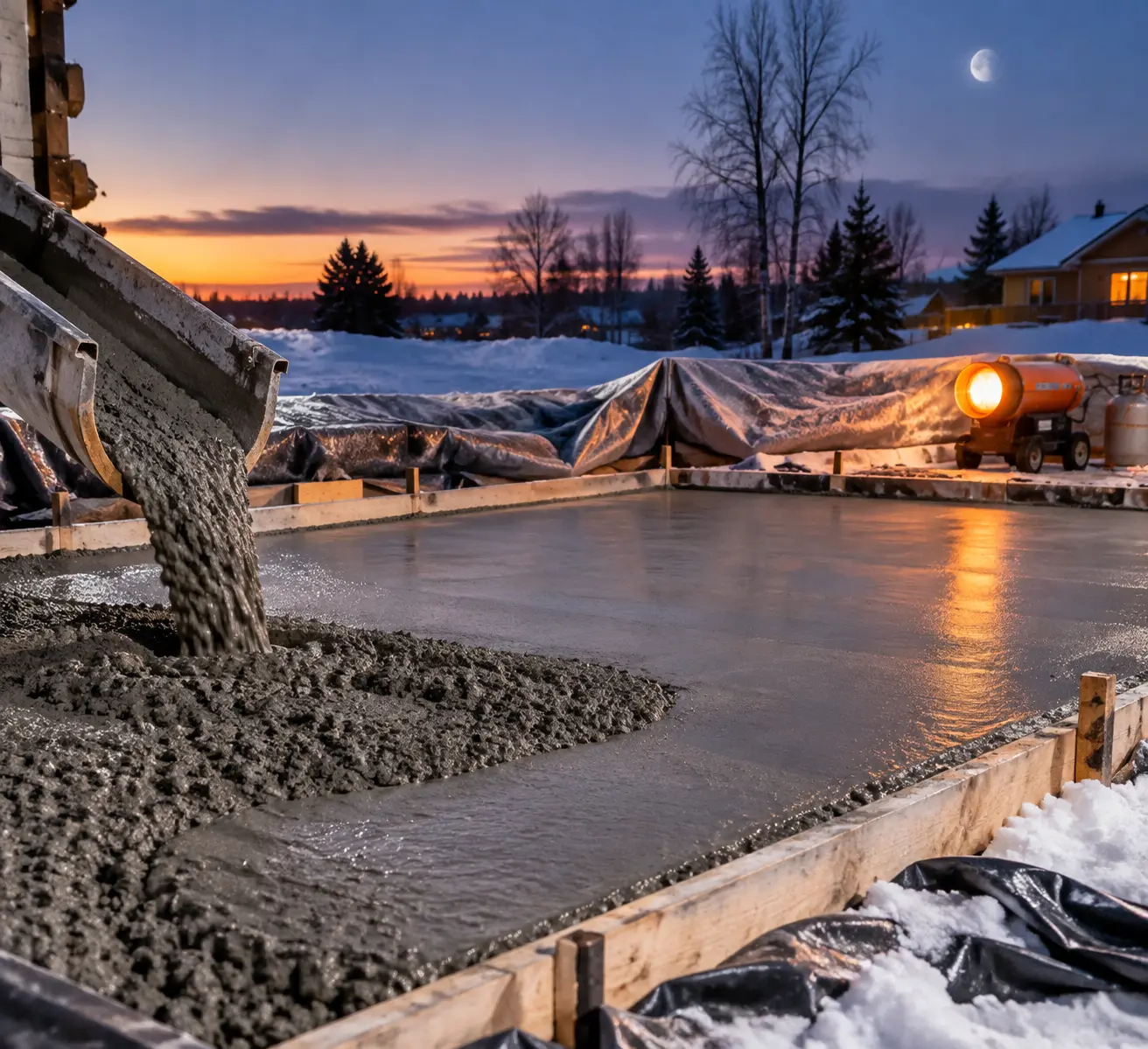
Do not place concrete on frozen subgrade. Frozen or ice-laden soil will thaw and settle after the pour, producing differential settlement and cracking. If frost depth, subgrade type, or structural loads are significant, check foundation and footing details; guidance on sizing footings and foundation pricing can help budget for additional excavation, deeper footings, or insulation layers Footings and Foundation Cost.
- Thaw or insulate the soil with rigid foam, straw and tarps, or a temporary heated layer to prevent conductive heat loss into frozen ground.
- Remove snow and standing water; embedded items must be dry and at a temperature compatible with the mix to avoid immediate thermal shock.
- Coordinate with the supplier to raise mix temperature through warmed mixing water and warmed aggregates when the specifications permit; this preserves water-to-cement ratio while improving initial temperature.
Protection Methods for Nighttime Freezes
The objective overnight is to maintain internal concrete temperature above freezing until the concrete reaches the early-strength target. Select methods by scale and duration of exposure and follow manufacturer instructions on overlap and anchoring.
- Construction-grade insulated blankets placed immediately over the finished surface. For small slabs and short-duration freezes, blankets alone are often sufficient; consider jobsite-rated blankets sized to overlap edges. For sourcing a practical protection product, contractors commonly use concrete curing blankets for cold-weather pours.
- Temporary heated enclosures or tents with indirect heaters. Use indirect-fired heaters or electric heaters with proper ventilation to avoid combustion gases contacting the slab surface.
- Insulated formwork and perimeter ground insulation on slabs-on-grade to reduce heat loss to the ground; this is especially important where the frost line is deep or subgrade is still cold.
- Electric heat-trace or powered blanket systems for long pours or when continuous controlled heat is required across a large area.
How Air Entrainment and Mix Decisions Affect Freeze Performance
Air entrainment improves freeze-thaw durability by providing a controlled system of microscopic voids that relieve hydraulic pressure during freezing. Research shows properly entrained mixes significantly reduce freeze-thaw scaling on low-permeability concrete; the air-void structure, not merely the presence of air, controls performance Freezing-thawing durability of low-permeability concrete with and without air entraining agent (InTrans, Iowa State).
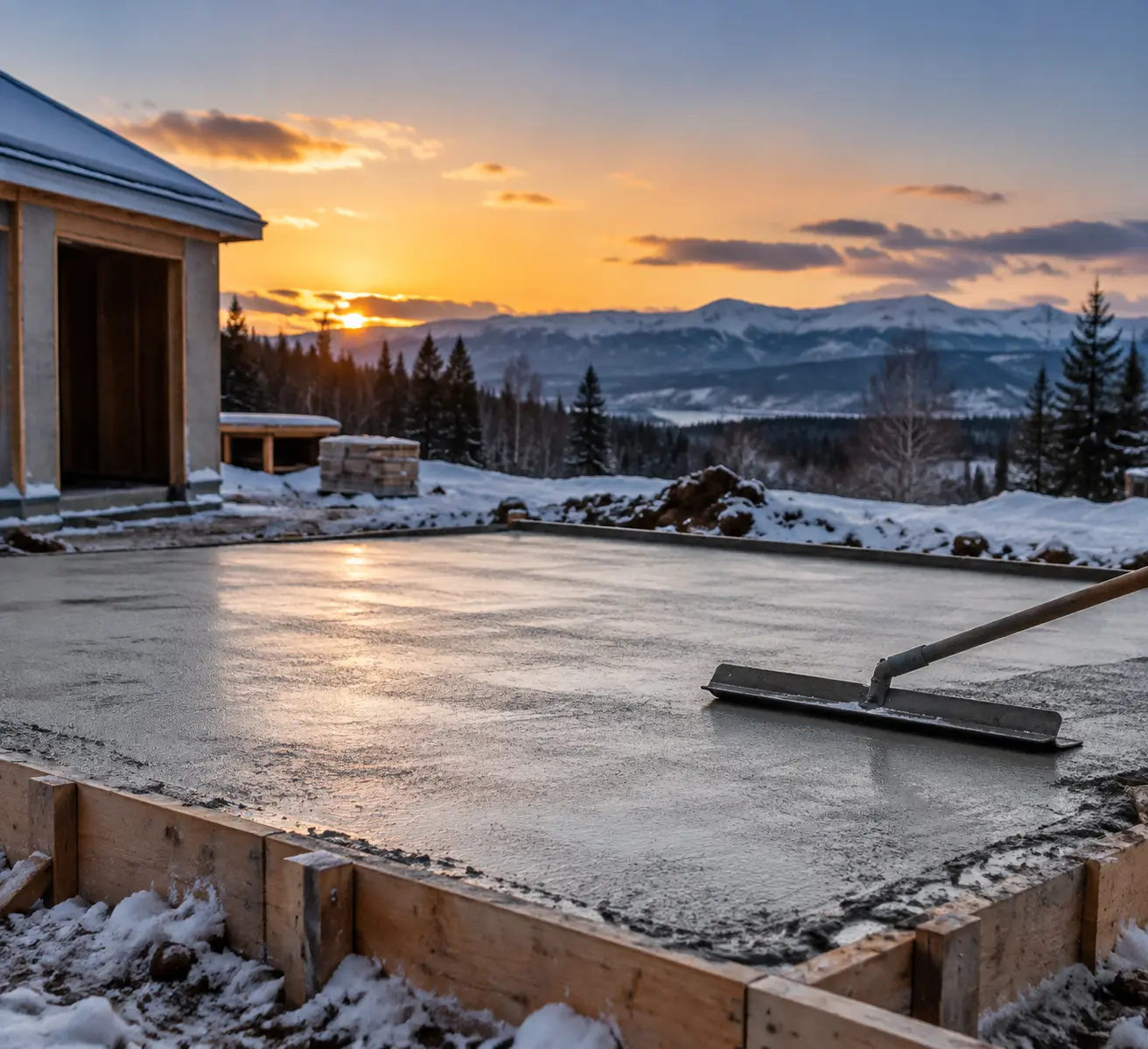
Use nonchloride accelerators to speed early strength where reinforcement is present. Avoid adding water on site to regain workability because added water reduces long-term strength and increases the risk of freeze damage. Any admixture or accelerator must be approved by the project engineer to avoid compatibility or corrosion issues.
Monitoring Temperature and Estimating In-Place Strength
Base removal of protection on measured data, not calendar days. Embedded temperature probes and maturity meters provide a reliable in-place strength estimate by translating temperature history into equivalent strength. Parallel compressive test cylinders cured under the same protected conditions and tested in the lab provide validation and a documented record for inspectors.
- Locate probes at representative slab depths and shaded areas to avoid optimistic surface readings.
- Use maturity-based charts supplied by the cement or meter manufacturer to convert temperature data into psi equivalent.
- Document daily temperature logs for inspectors and for the construction record; retain at least the first 7 days of data when possible.
What to Do If Fresh Concrete Freezes Before 500 Psi
If freezing occurs before the early-strength benchmark, expect reduced compressive capacity and increased permeability. Structural elements that froze at low strength typically require removal and replacement. For nonstructural slabs, test data from protected cylinders and a structural engineer’s assessment can support repairs such as surface overlays, partial replacement, or acceptance with recorded use limitations.
Common Mistakes That Lead to Frost Damage
- Placing concrete on frozen or inadequately insulated soil, which permits later thaw settlement.
- Relying solely on heat of hydration for protection when air temperature and wind will produce rapid radiational and convective losses.
- Using chloride-based accelerators near reinforcement, increasing corrosion risk.
- Failing to plan for wind and radiational cooling that accelerate overnight heat loss.
Regulatory Guidance and Local Examples
Follow ACI 306R for minimum protection procedures and documented cold-weather plans. Local jurisdictions may mandate specific protection temperatures or inspector verification of methods. As a local-code-informed example, Johnston County publishes a cold-weather concreting guidance sheet that defines cold weather conditions, air entrainment expectations, and recommended protection and curing practices Cold Weather Concrete guidance from Johnston County Inspections.
Practical Nighttime Workflow Checklist
- Confirm subgrade is thawed or insulated and remove visible ice or snow.
- Preheat permissible mix components and set up blankets or a heated enclosure before the pour.
- Place and finish concrete efficiently, then install insulation and blankets immediately to reduce exposure.
- Monitor temperatures overnight and maintain protection until probes or maturity indicate equivalent early strength of ≥500 psi.
- Remove protection gradually to avoid thermal shock; document the removal and any follow-up curing actions.
Products, Emerging Strategies, and Jobsite Selection
Construction-grade insulated blankets, indirect heaters, drum and tote heaters for admixtures, and electric heat-trace systems are standard. Emerging materials such as self-heating concrete with phase-change materials offer alternative strategies to reduce surface icing and may influence long-term planning for high-exposure slabs Drexel’s self-heating concrete with phase-change materials. For conventional protection, choose equipment rated for jobsite conditions and follow manufacturer guidance for overlap, anchoring, and ventilation when using fuel-fired heaters.
For budgeting and related site-specific planning, compare cold-weather protection costs to the risks and replacement costs; for example, contractors estimating patio or small-slab work sometimes use local installation cost guides when factoring heater, blanket and labor premiums Concrete Patio Installation Quote Chicago and for structural footing contingencies consult typical footing cost overviews Concrete Footings Cost.
Conclusion
Pours that encounter overnight freezes can succeed when planning, mix design, protection and measured strength verification are used together. Prioritize preventing early freezing, select protection appropriate to the scale of the work, and remove protection only when probes, maturity data, or tested cylinders confirm the concrete has reached the required early strength.
Related Video
When considering whether to pour concrete in freezing temperatures, it's essential to understand the risks involved. Concrete needs to cure properly to achieve its strength and durability. Cold weather can hinder this process, leading to cracking or weakening of the material. It may be possible to work with concrete in winter conditions, but specific precautions such as using heated enclosures or additives are often necessary to ensure a successful pour.
More from Architecture Adrenaline
For those wanting more insights like this, check out our social media channels where we regularly share updates and information about construction and design practices. Connect with us on Instagram for more content.